
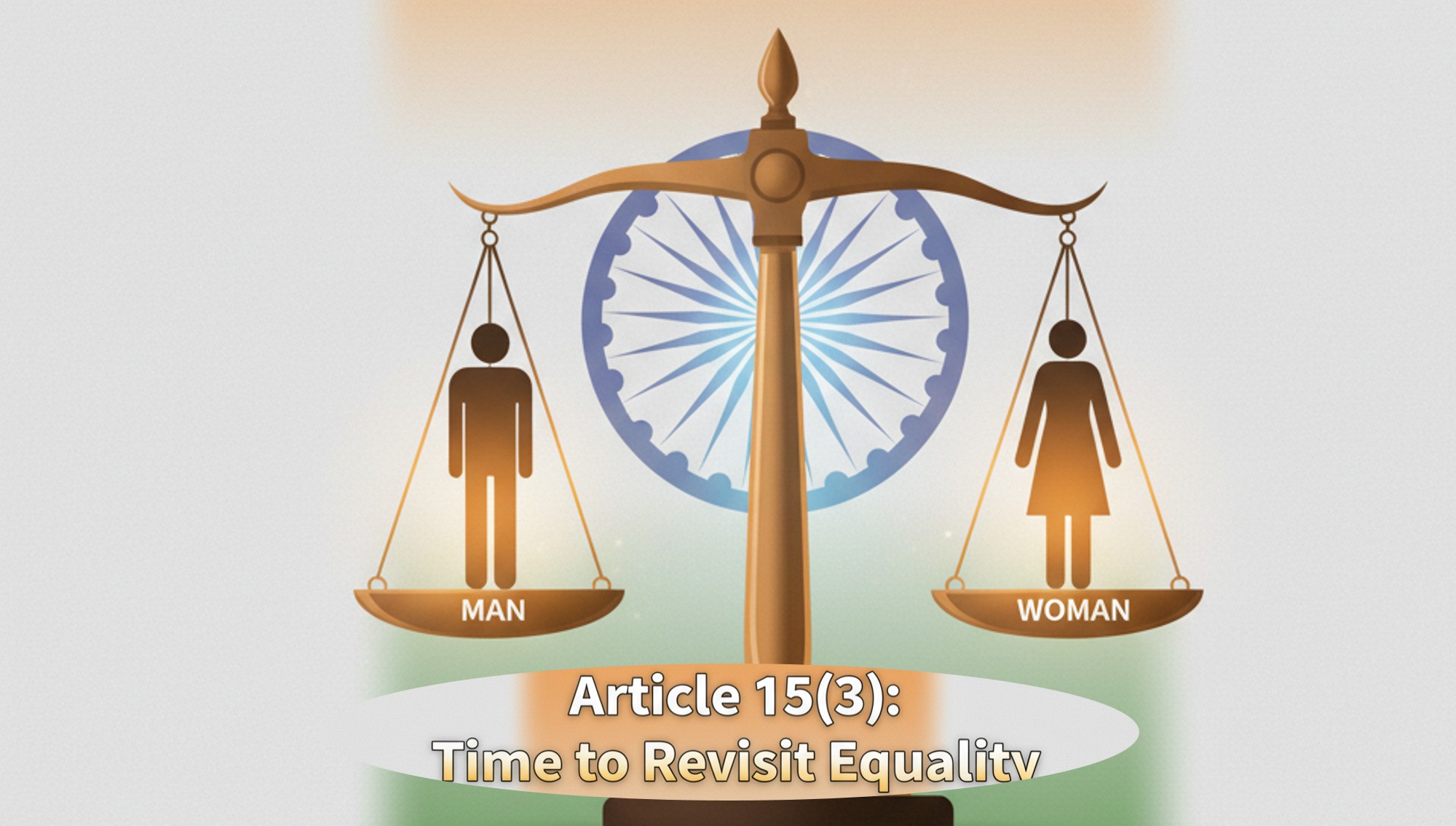
Article 15(3) gave special protection to women, but 75 years later, has it turned into a permanent exception to equality? A call for gender-neutral reform.
The Constitutional Irony
The Constitution of India stands as a symbol of justice and equality. Yet, hidden within its noble ideals lies a provision that continues to divide opinion even after seventy-five years — Article 15(3), which allows the State to make “special provisions for women and children.”
While the lawmakers introduced it in 1950 believing women facing social disadvantages, it has never been subjected to periodic review. What began as a temporary support mechanism has evolved into a permanent exception to equality, raising serious questions about its alignment with Articles 1 and 13 of the United Nations Charter, which guarantee equality without distinction of sex, religion, or any other status.
"Temporal justice with Article 15(3), it must have a sunset clause or periodic review, not remain an eternal exception to equality.", Kumar S. Ratan
When History Was Different
Before Independence, India was largely rural, underdeveloped, and disconnected. Small villages (most of them were five or ten homes) scattered across forests and hilly terrains with no roads, transport, or basic schooling. Even men had to travel in groups to avoid forest bandits (dasyus). In such conditions, women’s access to education and mobility was naturally limited, not because of deliberate oppression but due to geography and poverty.
It was belived by then lawmakers that with Article 15(3), it will bridge opportunity gaps in a society struggling with basic development fro women. But context changes, and law must evolve with it. Unfortunately, India never revisited the context. What was relevant in 1950 has been allowed to operate unchanged in 2025.
Politics Over Principle
Instead of reviewing it, political parties found it convenient. “Women-centric” schemes became easy vote-bank tools rather than adopting gender-neutral welfare frameworks.. Real empowerment got replaced with tokenism, and feminism was redefined as exclusive entitlement.
This shift, amplified by global feminist narratives, gradually disconnected from India’s ground reality. Men continued to suffer from illiteracy, unemployment, and lack of institutional support, yet public policy framed gender imbalance as a one-sided oppression story.
The 70-Year Aftermath
The results are visible today:
- Family laws presume male guilt in domestic and dowry case.
- Custody laws sideline fathers.
- Suicide data show increasing male distress linked to family conflicts.
- Traditional family harmony is fading as gender-specific laws divide rather than protect.
The protective clause that once sought balance now fuels discontent and distrust within families — the very foundation of social stability.
Equality Needs Expiry Dates
If affirmative action is justified, it must also be reviewed. True equality demands:
- Periodic assessment — every decade, to test relevance.
- Gender-neutral policies — aid based on vulnerability, not sex.
- Accountability — data, not ideology, should drive decisions.
Without timelines, protection becomes privilege — violating the essence of Articles 14 and 15(1) themselves.
Toward Balanced Equality
India now needs a Constitutional Review to re-examine Article 15(3).
Empowerment should mean equal access and fair justice for every citizen — man, woman, or child.
Only when equality becomes neutral, inclusive, and time-bound can the dream of justice truly be fulfilled.